The Data Foundation Decides the Fate of Every AI Program
Models are becoming a commodity. The durable advantage now sits in integrated, governed and observable data, and in the discipline to build it before the demo.
Read the insight →Peppol's five-corner model places the tax authority inside the invoice flow. The UAE and Singapore are rolling it out now, and ERP readiness is the critical path.
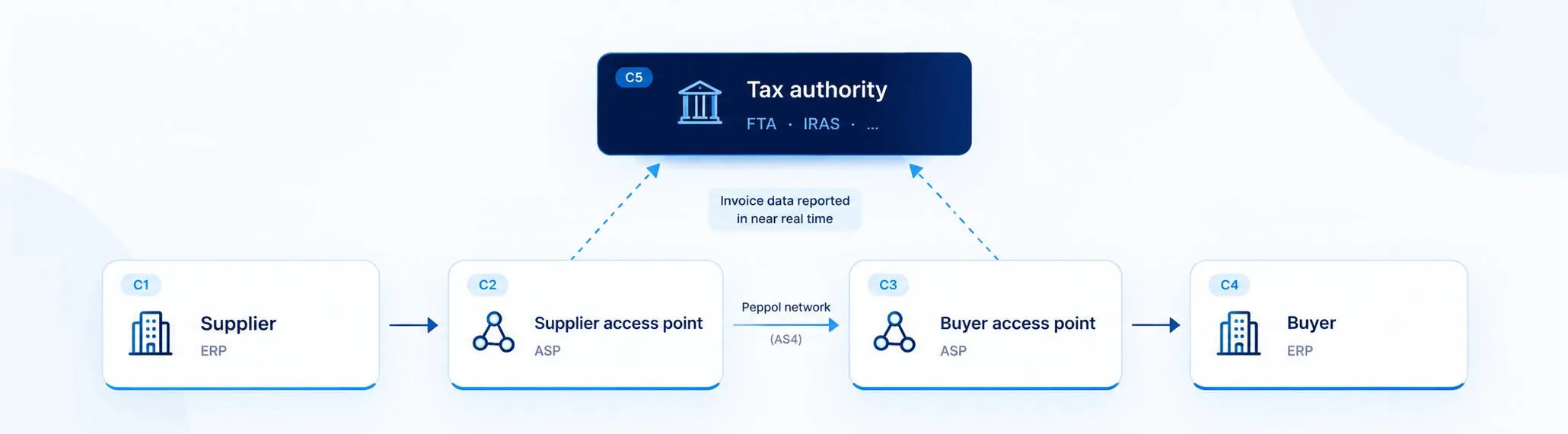
For years Peppol was defined by its four-corner model. A supplier (Corner 1) sends an invoice through its access point (Corner 2) to the buyer's access point (Corner 3), which delivers it to the buyer (Corner 4). One connection lets any business reach any other, much as email does.
The five-corner model adds a fifth participant, the tax authority. As the invoice passes between access points, its tax data is reported in near real time. Audits move from periodic requests to continuous transaction controls.
Consumption taxes lose revenue to invoice fraud, missing-trader schemes and simple error. Real-time data lets authorities pre-fill returns, match input and output tax and detect anomalies early. Building on Peppol also gives businesses one international exchange standard instead of a different national portal in every market.
| Country | Model | Announced timeline |
|---|---|---|
| UAE | Five-corner Peppol with PINT AE and Accredited Service Providers | Pilot from 1 July 2026. Businesses with revenue of AED 50 million or more go live on 1 January 2027, with an ASP appointed by 31 July 2026. Other businesses follow on 1 July 2027 and government entities on 1 October 2027. |
| Singapore | GST InvoiceNow, five-corner, reporting to IRAS | Mandatory for new voluntary GST registrants since 2025 and 2026, then phased by turnover to all GST-registered businesses by 1 April 2031. |
| Europe | Four-corner Peppol with reporting planned | Belgium made B2B Peppol invoicing mandatory in January 2026, and several EU states plan e-reporting in later phases. |
Timelines as published in September 2026. Confirm against the latest guidance from the relevant tax authority.
N-Tax, our Peppol five-corner platform, sits between the ERP and the network. Each company works in its own workspace. N-Tax generates and validates PINT AE invoices, exchanges them with the buyer's access point and reports everything sent to the Federal Tax Authority, then returns status to the source system. For NetSuite and other ERPs, compliance becomes a connector project instead of a rebuild.
Insights-as-a-Service: Once invoices flow as structured data, they become a live source of insight. We turn e-invoicing data into weekly views of VAT exposure, rejection trends and customer payment behavior. How it works →
One short email a month with patterns we see across data platforms, AI programs and e-invoicing rollouts. Longer essays are on our Substack.